 NexSHOPX-官方新闻
Searching for finished account purchase, why is it that when you click into different product pages, the same type of account is priced at two or three yuan on some, dozens on others, and even hundreds for specs with membership or aged accounts?
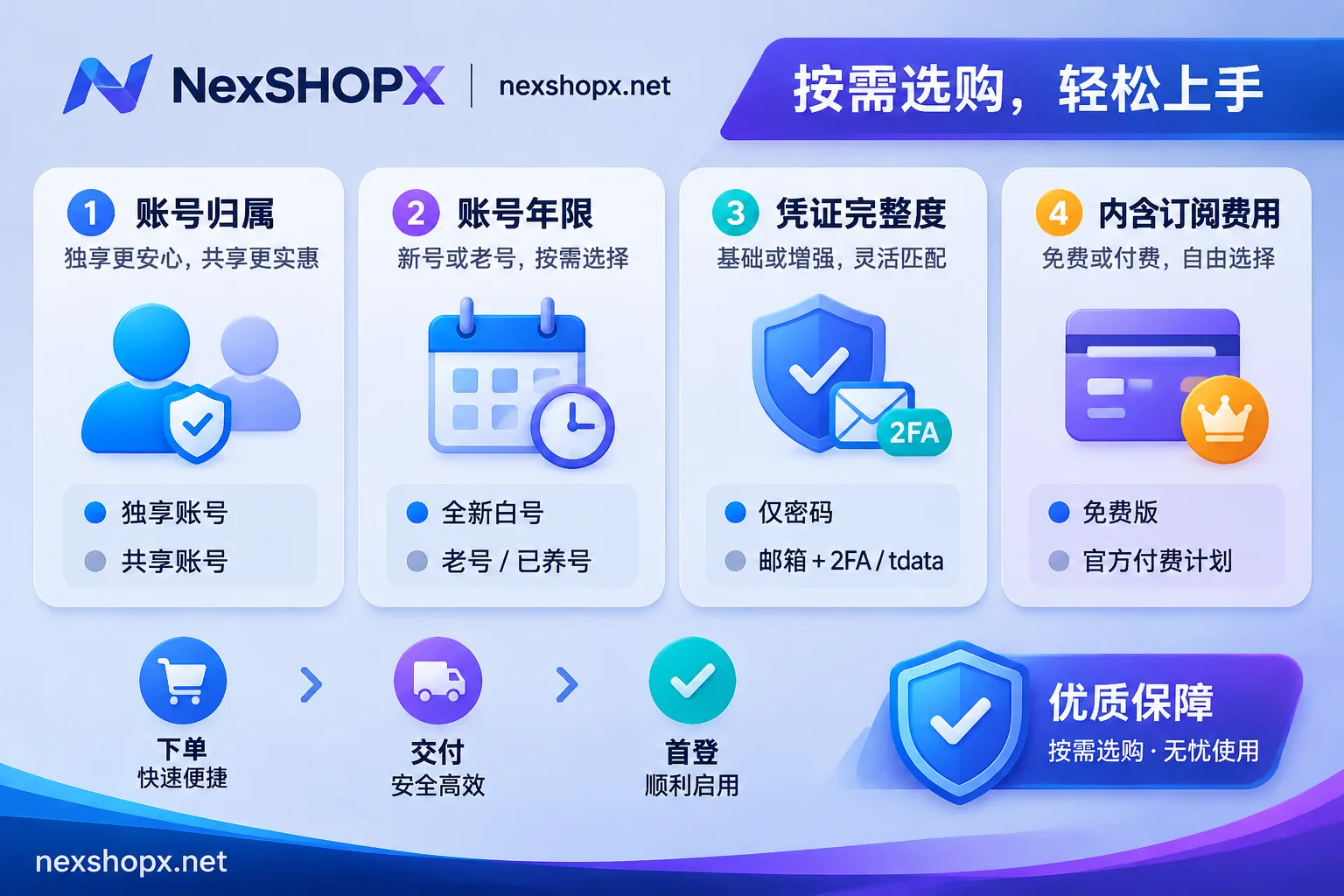
Conclusion first: The reason the same finished account can have a price difference of several times or even tenfold or more mainly comes down to four cost factors—ownership (exclusive vs multi-person shared), registration and account nurturing weight (machine-registered blank account vs manual aged account/unlocked account), completeness of delivery credentials (account password only vs with recovery email and 2FA access), and whether the official mandatory membership subscription fee is included. The "cabbage price" below a reasonable cost line usually saves on IP purity, re-verification channels, and after-sales warranty, and often fails directly upon first login or when changing devices.
Before buying an account, understanding the rules and pricing logic behind the product page is far more important than blindly comparing prices.
1. The 6 Most Common but Easily Misjudged Spec Jargons on Product Pages
Many beginners feel the account is "not as described" after purchase, but it's often because they didn't understand the spec terms on the product page before ordering.
1. Exclusive Account vs Shared Account (Carpool Account)
This is the biggest price divide, most common in AI tools and streaming categories:
- Exclusive Account: After delivery, the account is for your use only, with complete login credentials, you can manage the bound email or two-factor authentication according to the rules, and chat history and viewing history are completely private. If it's an exclusive finished account with an official website subscription (e.g., ChatGPT Plus official monthly fee of $20, Netflix US 4K premium monthly fee of $26.99), the merchant's cost naturally includes this mandatory subscription fee.
- Shared Account / Carpool Account: Essentially multiple people sharing a high-tier account or family slot, common in low-priced AI trial accounts or streaming carpools. Some shared accounts only deliver temporary login status or cookies, cannot change password or binding, everyone shares the usage quota, and cross-regional multi-person logins are more likely to trigger verification or disconnection.
Selection Tip: If you already have an account you've used long-term and have important history, you don't need to buy an expensive finished account again; going through original account activation/recharge is often more cost-effective and won't lose data. For example, at NexSHOPX, you can purchase finished accounts for various platforms, and also separately offer original account activation services for ChatGPT Plus/Pro, Claude, Grok, Telegram Premium, X membership, and Netflix, and the product page clearly indicates whether it's "exclusive" or "shared" and the concurrent device limit.
2. Direct Login New Account vs Locked Pending Unlock Account vs tdata / API Protocol Account
Also called "brand new finished account", but the login and takeover threshold can be completely different:
- Direct Login New Account: You can log in and use it immediately with the account password upon receipt, without additional verification code. For example, a brand new exclusive email account can send and receive emails right away.
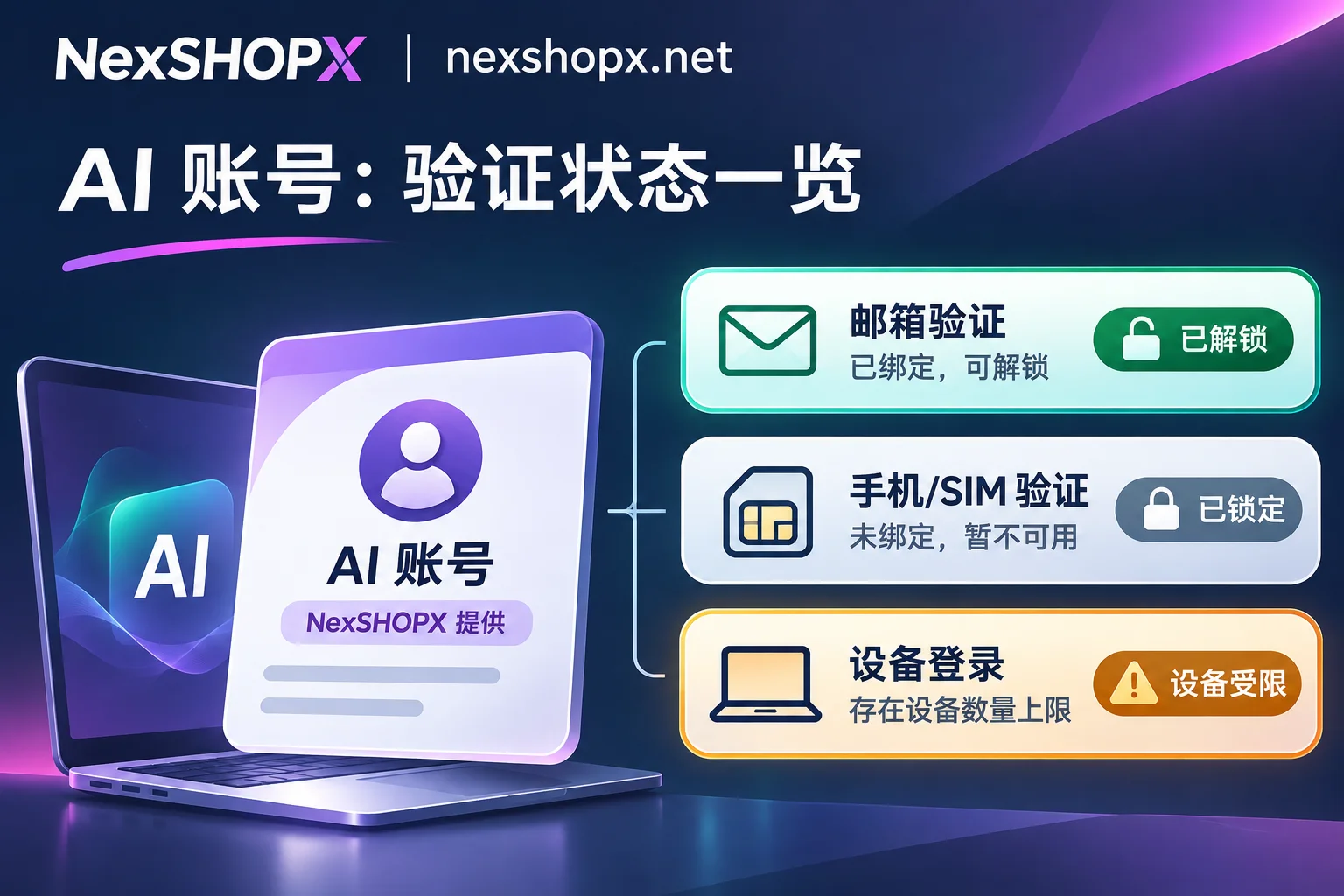
- Locked Pending Unlock Account: Common in Outlook/Hotmail email categories, priced significantly lower than direct login new accounts because the buyer needs to verify with their own phone number upon first login to unlock and activate. If you don't read the description carefully and snap it up for cheap, you may get stuck at the first login step.
- tdata / API Protocol Account: Common in social categories like Telegram.
tdatais a desktop login status folder that needs to be imported into the Telegram Desktop client; API specs are for development testing or specific tool integration. Individual users without a matching desktop client or technical background often don't know how to log in after buying this type of spec.
3. Blank New Account vs Aged Account with Purchase History / Year-Old Account / Secondary Unlocked Account
The account's "resume" directly determines how many business operations it can withstand (for the underlying difference between new and aged accounts, you can refer to What's the difference between new and aged finished accounts):
- Blank New Account: No historical purchases, no posting interactions, suitable for downloading regional apps, receiving registration verification codes, or low-frequency testing.
- Aged Account with Purchase History: For example, foreign Apple ID aged accounts with in-app purchases and billing traces, compared to blank new accounts with no balance, have higher risk tolerance when subscribing to regional services.
- Year-Old Account: Like early X (Twitter) aged accounts registered between 2007–2019, or overseas email aged accounts with over a year of history; due to limited stock and long registration history, the unit price is completely different from ordinary new accounts.
- Secondary Unlocked Account: Common in Facebook advertising scenarios, refers to accounts that were once restricted by the platform but have been restored through appeals, some can change currency, bind payment, or come with personal ad accounts, specifically prepared for high-risk advertising business, so the cost is naturally much higher than ordinary blank accounts.
4. "Standard Registration Account" vs "Plus Upgradable Account"
Taking OpenAI (ChatGPT) as an example, ordinary standard accounts only complete email and basic verification, suitable for using free quota; while "Plus upgradable" ready-made accounts have pre-arranged registration environment and verification steps, making it convenient to bind payment and upgrade to high-tier subscription later. The two have different positioning, so the price naturally differs.
5. In-Stock Automatic Delivery vs Manual Pre-Order Spec
Standard email, regular social media new accounts, etc., often support automatic card delivery after payment; but scarce year-old Twitter accounts, cross-border e-commerce accounts (like Shopify, OLX), WhatsApp business accounts, or Telegram accounts with specified country codes, due to large inventory fluctuations and the need to verify region and qualifications, mostly adopt a pre-order model of "contact customer service to confirm before delivery". For more differences, see What's the difference between in-stock automatic delivery and pre-order products.
6. Pure Receiving Email vs Email with IMAP/POP/SMTP Protocol Enabled
Many development testing or overseas customer acquisition buyers only buy email at the lowest price, only to find that the low-priced spec only supports web login with account password, or can only receive verification codes but not send emails, and cannot connect to clients or automated processes. Before ordering, you must confirm whether IMAP/POP/SMTP permissions are enabled.
2. 4 Red Lines for Price and Delivery: Which Low-Priced Accounts Should You Avoid?
When comparing prices, if you find a quote that clearly goes against common sense, check against these four red lines first:
- "Two or three yuan blank accounts" far below normal market labor and number costs
For example, social media new accounts for two or three yuan, or foreign Apple IDs as low as a few yuan. Such accounts are likely batch-registered by scripts, using IP ranges already flagged by the platform, many accounts survive less than 72 hours, or even trigger risk control upon first login, and usually "deleted upon sale, no after-sales". - Claiming "high-tier exclusive" at a price below the official membership mandatory cost
As long as the product includes an official monthly subscription, there is no "ultra-low-priced exclusive" that violates exchange rates and official pricing. Finished accounts far below the official base price but claiming exclusivity usually have only two tricks: packaging multi-person carpool sharing as exclusive, or using high-risk gray payment card segments to activate, which may be reclaimed by the official within a few days. - "Three-no accounts" that only give account password without recovery channel
High-risk platforms (like social media, Apple, Google ecosystems) are very likely to pop up secondary verification when changing devices or networks for first login. If the seller only sends a set of account password, neither the bound recovery email nor the 2FA key or setup guide, the account will be immediately scrapped once verification is triggered, and there is even the risk of being recovered by the original holder through initial information appeal. For complete handover standards, see Is it considered complete delivery if only account and password are given. - Sellers claiming "100% never banned" but not clearly stating warranty boundaries
Any finished account is subject to platform anti-fraud rules and the buyer's own usage environment; promising "absolutely never banned" itself goes against platform logic. Reliable platforms will instead explain the rules thoroughly: specify the time limit for first login after order, which information must not be modified during the warranty period (e.g., some categories lose after-sales if information is changed during warranty, see What does it mean that information cannot be changed during warranty), and bans caused by aggressive marketing, frequent IP switching, or account sharing are not covered by warranty.
3. How to Match Different Uses and Budgets Without Wasting Money?
You don't have to buy the most expensive year-old account, nor use a few-yuan test account for core business. Just follow this comparison table:
| Real Use Scenario | Recommended Account Spec | Key Pitfall Avoidance |
|---|---|---|
| Download overseas apps / subscribe to regional apps | Blank new Apple ID for the corresponding region; choose aged accounts with purchase history for stable subscriptions | Specs with unactivated iCloud and no payment method bound are cleaner; do not log in with cross-region IPs |
| Software registration verification / development testing | Brand new exclusive Gmail, Onet.pl/Yahoo etc. overseas emails, or Outlook direct login new accounts | For client or automatic email receiving, confirm IMAP/POP/SMTP is included; low-priced "pending unlock accounts" require your own phone number to unlock |
| High-frequency use of AI tools (ChatGPT/Claude/Grok) | If you have a main account, choose original account activation/recharge; if you need an independent new environment, choose exclusive finished account or Plus upgradable account | If you need to keep private conversations or development code context, never choose shared carpool accounts to save money |
| Personal binge-watching (Netflix etc.) | For fixed device solo viewing, choose exclusive or compliant activation; if budget is limited and you accept single-device rules, consider sharing | Pay attention to the quality tier (standard/4K) and the maximum number of devices allowed to log in simultaneously indicated on the product page |
| Cross-border e-commerce store opening / social media advertising operations | Nurtured finished accounts for the corresponding region, TikTok Shop/live accounts, Facebook secondary unlocked accounts, year-old accounts | Be sure to confirm region match and historical weight in advance; never aggressively send private messages, batch add friends, or launch ads immediately after receipt |
If you're still unsure whether registering yourself or buying directly is more cost-effective, first calculate the phone verification and trial-and-error time cost, refer to Buying overseas accounts or registering yourself.
4. Find a Procurement Channel with Transparent Specs and Clear After-Sales Boundaries: NexSHOPX as an Example
After understanding the specs, the core of choosing a channel comes down to three things: whether the categories are clearly layered by use scenario, whether delivery and order tracking are traceable, and whether warranty rules are publicly disclosed in advance.
Take NexSHOPX, a virtual account mall for individual membership procurement and cross-border teams, as an example. When making a finished account purchase, the site breaks down all confusing specs to avoid blind buying pitfalls:
- Clear layering of basic ecosystems and emails: Apple ID is divided by regions such as US, Japan, Hong Kong, Taiwan, Turkey into blank new accounts and aged accounts with purchase history, by default with regional address added, no payment bound, and iCloud not activated; Gmail and Outlook/Hotmail clearly distinguish brand new direct login, low-priced pending unlock (requires your own phone verification), and whether IMAP/POP/SMTP permissions are enabled, and each overseas email is sold only once.
- Business and social media accounts segmented by scenario: Instagram, TikTok (aligned with IP, time zone, and device environment by region, distinguishing ordinary content accounts and advanced e-commerce accounts), Facebook secondary unlocked aged accounts, Twitter year-old accounts, and Telegram (covering tdata, API, and multi-region pre-orders) all separately list applicable scope and modification restrictions.
- Finished accounts and original account activation in parallel: AI and streaming sections (like OpenAI, Claude, Netflix, etc.) offer both ready-made accounts and original account recharge, making it flexible for you to choose "isolate new account" or "keep old account records".
- Transparent ordering and pre-disclosed warranty boundaries: Support registered ordering or guest ordering without registration, settlement in RMB (Alipay and USDT supported). In-stock items are automatically delivered after payment confirmation, and you can retrieve credentials anytime with the order number on the order query page; for pre-order and customized products, you can confirm region, year, and stock with Telegram customer service before ordering. Specific prices, real-time inventory, first login time limit, and warranty days are subject to the product page and Terms of Service and Warranty Rules.
Special note on boundaries: NexSHOPX only provides compliant virtual account and membership procurement services (orders cannot be canceled after successful payment unless otherwise specified). Peripheral infrastructure such as multi-account fingerprint browsers, proxy IPs, verification numbers, or network acceleration tools need to be configured separately by teams or individuals according to their own business needs.
5. 3-Step Pitfall Prevention Check After Order Delivery
No matter which platform you purchase finished accounts from, after payment and receiving the card password, follow these three steps to avoid most "banned right after purchase" problems:
- Align the login environment before entering account password: Ensure the current device network matches the account registration region; don't log in directly with a domestic or Japanese node right after getting a US account.
- Complete first login within the specified time limit and verify credentials: Don't stockpile and ignore. Complete first login according to the order page instructions as soon as possible, verify whether the email, auxiliary recovery information, or
tdatafile is complete. - Check warranty modification restrictions first, then secure the account: If the product page allows password change and 2FA binding, change it promptly after stable first login and properly save the key; if the product page states "modification of information is prohibited during warranty", be sure to wait until the observation period passes before gradually taking over according to the process, to avoid losing replacement after-sales due to improper operations.